
pmxt
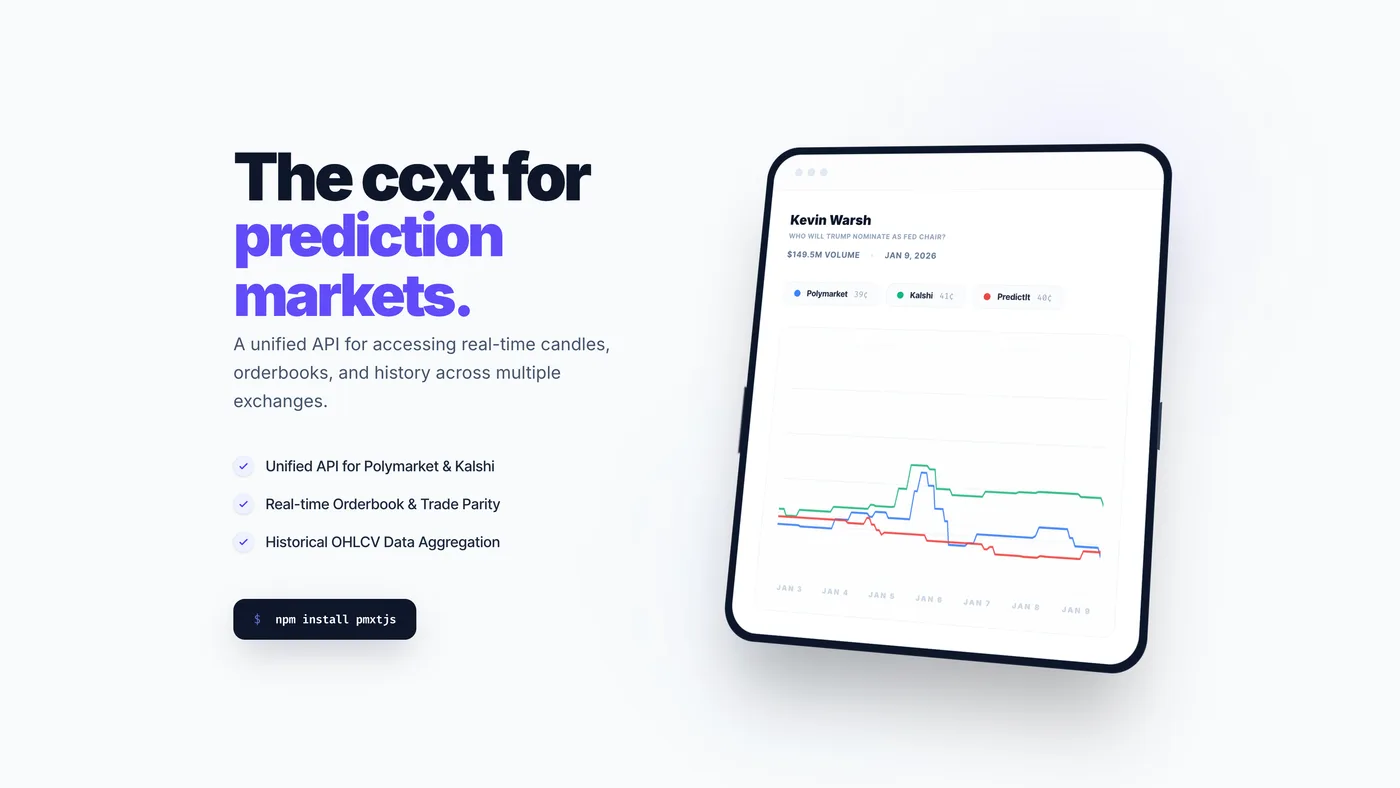
An open-source unified API and SDK for prediction-market discovery, data and supported trading across venues including Polymarket, Kalshi and Limitless, with Python, TypeScript, CLI and MCP interfaces.
Checked Nov 16, 2026
- Price
- Free
- Made by
- pmxt.dev Source
- Works on
- Python, Node.js, Command line, MCP, API, Self-hosted
- Open source
- Yes
- AI features
- AI integration
- Category
- Market data APIs
Not confirmed yet: launch date. Check the official site.
What it is for
Reduces venue-specific integration work for market data and trading applications; useful to developers building agents, research tools or multi-venue workflows.
Compared in Prediction market APIs compared
Alternatives to pmxt
- Assymetrix Data APIA normalized data API for querying markets, events, trades, historical candles and order-book depth across Polymarket, Kalshi and Limitless.Free plan
- Kalshi Python SDK by TexasCodingAn open-source Python client for Kalshi API workflows, including market data and account operations.Free
- PolyRouterUnified prediction-market data API with market discovery, price history and an MCP integration.Free plan
- Polymarket APIOfficial Polymarket developer documentation for market discovery, market state and fee metadata.
- Polymarket CLIExperimental Polymarket-published Rust CLI for market and order-book browsing, JSON output, positions and orders. Most research commands need no wallet; trading and account commands require wallet credentials.
- AdjacentIndex provider and data company for prediction markets, with indices, reference rates, a REST API and an MCP server for Kalshi and Polymarket data.Free plan


OUR TAKE / EDITORIAL OPINION
pmxt should preserve the awkward parts of each venue
A unified interface is valuable only if its boundaries remain understandable.
pmxt documents a unified prediction-market API and SDKs, self-hosting, supported hosted trading and an MCP interface for AI clients. The MCP interface is an integration surface, not evidence of a built-in forecasting model. Our view is that the strongest case for a common interface is repeatable engineering, rather than the appearance that every venue behaves identically. We would want a developer to know exactly when the abstraction stops.
We would shortlist pmxt for a team that already has a concrete workflow to implement across venues. The tradeoff is shared application code versus dependence on the toolkit’s translations and supported operations. Hosted trading should be evaluated only for the venues and writes the documentation actually supports. Self-hosting and hosted access also deserve separate assessments of credentials, operations and responsibility.
Choose one intended workflow and create a support matrix: discovery, data retrieval, order submission, cancellation and error reporting where applicable. Check every required operation against each intended venue, then inspect an unsupported case and a failed request. A clear, actionable error is part of the product, not an edge detail. Hosted pricing remains unverified here. We would adopt the toolkit when its explicit boundaries simplify the application, rather than when a broad feature list makes those boundaries harder to see.
AI-assisted editorial analysis based on cited documentation; not a hands-on product test.
Sources for this opinion: Source 1
AI features
The official project publishes MCP for external AI clients; it is an integration surface, not a forecast model. Hosted writes are documented for Polymarket, Opinion and Limitless; other venue writes may require self-hosting and venue credentials. Execution was not tested.
Pricing
Free. SDKs and local server are MIT-licensed open source. A hosted API with a key also exists.
Prices change. Check the official site before you sign up.
Sources3
We read the official product documentation. We did not test the product.
- Checked Nov 16, 2026
- Checked Oct 8, 2026
- Checked Oct 8, 2026